
The Transformative Justice Coalition and the Voting Rights Alliance, in honor of Black History Month, are reviving the daily special series devoted to sharing the legacies and stories of the sheroes, heroes, and events in the fight for Black suffrage. This series was created in 2017 and added 4 NEW articles this year, and several newly revised, updated, or corrected ones. In addition to these daily newsletters all February long, this series also incorporates daily social media posts; an interactive calendar; and, website blog posts to spread the word broadly.
We encourage everyone to share this series to your networks and on social media under the hashtag #VRABlackHistory. You can also tweet us @TJC_DC to share your own facts.
Barbara Arnwine insisted that we could not have another year without publishing our Black History series! All month long, we have honored, recognized, and educated about a person, organization, or event, spanning over 5 centuries and told in chronological order, about those moments that forever changed the movement for African-American suffrage. The Transformative Justice Coalition thanks those who have been republishing our articles, on Facebook, Twitter, LinkedIn, your websites, and even in the Tennessee Tribune. Over the 28 days of February 2022, these Black History emails were opened over 65,000 times, with over 600 individual clicks. You have responded to these emails with corrections, more information, asks to republish the series, and by expressing your thanks. We want to also extend our gratitude for your appreciation of the history this series shares.
This article is written by Caitlyn Cobb. All the sources are linked throughout the article with a full reference list at the end of the full article which can be read by clicking the button at the bottom of the page). This is an introductory summary page.
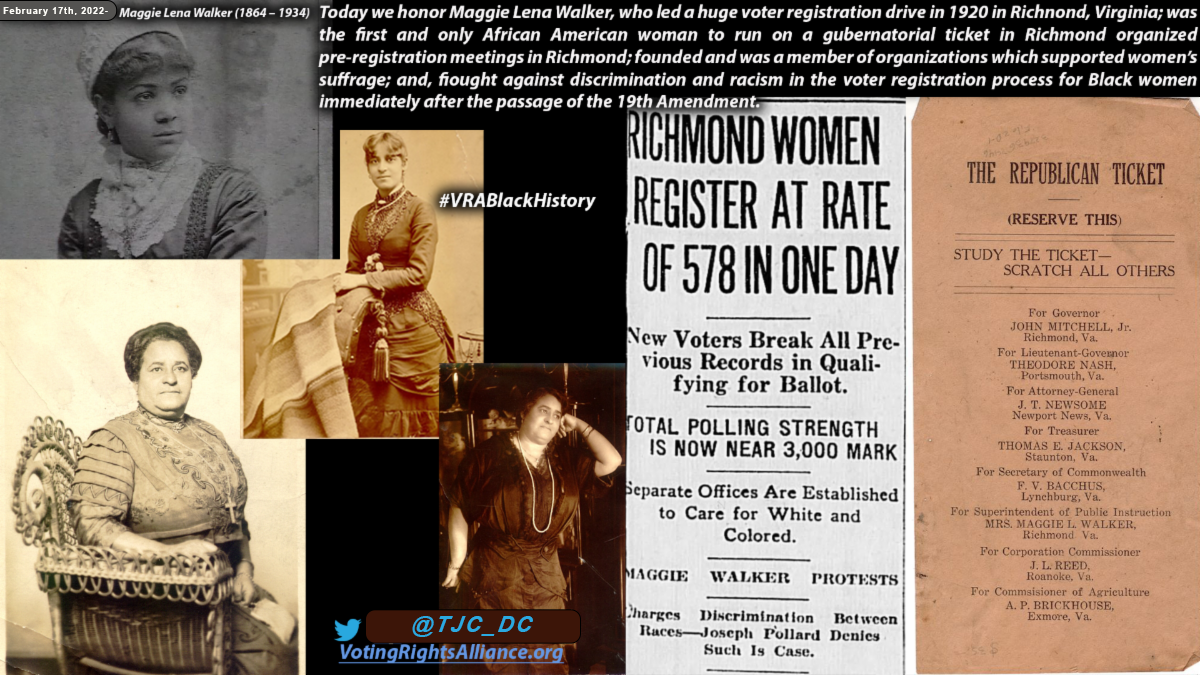
Today, February 17th, 2022 we honor Maggie Lena Walker. Maggie organized pre-registration meetings in in 1920 in Richmond, Virginia after the ratification of the 19th Amendment.
Those meetings led to a huge voter registration drive for African American women and resulted in the highest rate of African American women registered to vote in Richmond that year.
Not only did Maggie lead this voter registration movement, fighting against discrimination and racism in the voter registration process for Black women. In 1921, Maggie became the first and only African American woman to run on a gubernatorial ticket in Richmond.
While Maggie is best remembered for founding the Saint Luke Penny Savings Bank in Richmond, Virginia, she also founded or was an active member of organizations which supported women’s suffrage.
Please note that the below version is a newly re-edited version of the original 2020 article. This special 2022 edition has been reformatted to set the scene for tomorrow's first NEW 2022 article which will detail the Black massacres that occurred when White Supremacists terrorized Black voters after the passage of the 15th Amendment. While honoring Maggie Lena Walker's little known voting rights legacy, this new edition aims to also highlight the vicious voter suppression tactics used against Black communities during the time period between the passage of the 15th and 19th Amendments.
The original 2020 Version was written specifically for the Centennial Anniversary of the 19th Amendment, and the main highlight was Maggie Lena Walker's work in organizing pre-registration meetings in 1920 in Richmond, Virginia after the ratification of the 19th Amendment. Those meetings led to a huge voter registration drive for African American women and resulted in the highest rate of African American women registered to vote in Richmond that year. Not only did Maggie lead this voter registration movement, fighting against discrimination and racism in the voter registration process for Black women. In 1921, Maggie became the first and only African American woman to run on a gubernatorial ticket in Richmond. While Maggie is best remembered for founding the Saint Luke Penny Savings Bank in Richmond, Virginia, she also founded or was an active member of organizations which supported women’s suffrage.
The major difference between the original version and this new version isn't new content, but a reorganization of the original article, although some content from the original has been removed from this version. All references for any further reading or sources are listed at the end of this article and this bibliography is the same as the original.