
The Transformative Justice Coalition and the Voting Rights Alliance, in honor of Black History Month, are reviving the daily special series devoted to sharing the legacies and stories of the sheroes, heroes, and events in the fight for Black suffrage. This series was created in 2017 and added 4 NEW articles this year, and several newly revised, updated, or corrected ones. In addition to these daily newsletters all February long, this series also incorporates daily social media posts; an interactive calendar; and, website blog posts to spread the word broadly.
We encourage everyone to share this series to your networks and on social media under the hashtag #VRABlackHistory. You can also tweet us @TJC_DC to share your own facts.
Barbara Arnwine insisted that we could not have another year without publishing our Black History series! All month long, we have honored, recognized, and educated about a person, organization, or event, spanning over 5 centuries and told in chronological order, about those moments that forever changed the movement for African-American suffrage. The Transformative Justice Coalition thanks those who have been republishing our articles, on Facebook, Twitter, LinkedIn, your websites, and even in the Tennessee Tribune. Over the 28 days of February 2022, these Black History emails were opened over 65,000 times, with over 600 individual clicks. You have responded to these emails with corrections, more information, asks to republish the series, and by expressing your thanks. We want to also extend our gratitude for your appreciation of the history this series shares.
This article is written by Caitlyn Cobb. All the sources are linked throughout the article with a full reference list at the end of the full article which can be read by clicking the button at the bottom of the page). This is an introductory summary page.
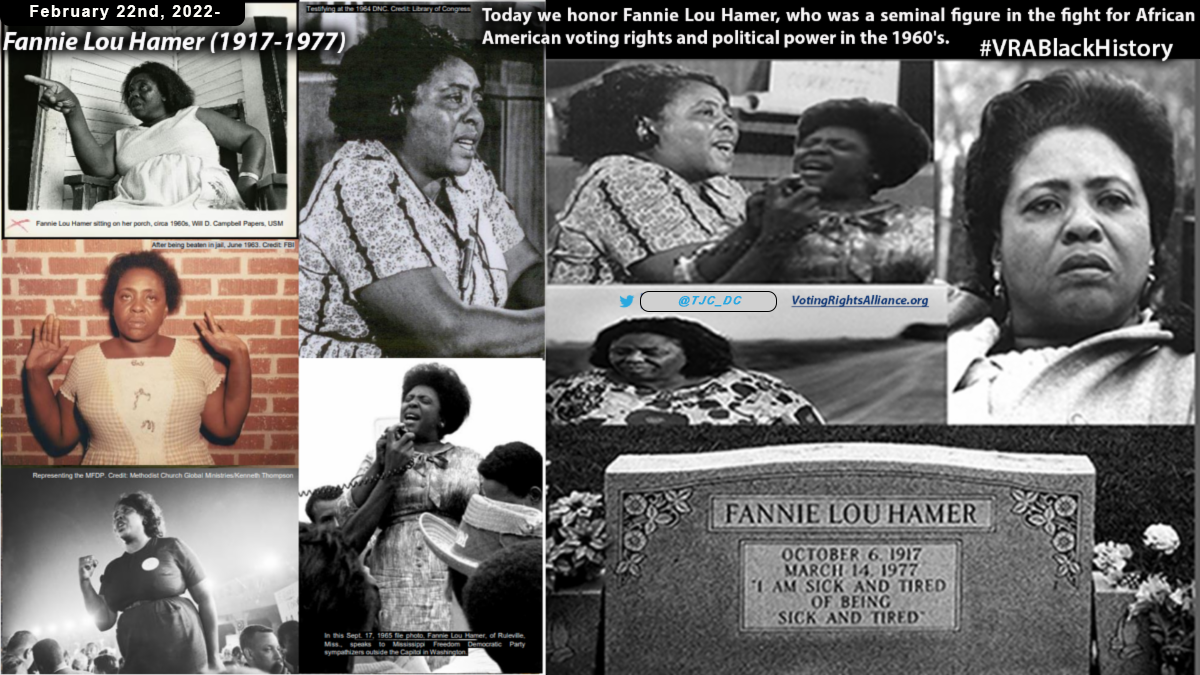
Today, February 22nd, 2022, we honor Fannie Lou Hamer, a seminal figure in the fight for African American voting rights and political power in the 1960's. Hamer "was a civil rights activist whose passionate depiction of her own suffering in a racist society helped focus attention on the plight of African-Americans throughout the South."
“During the course of her activist career, Hamer was threatened, arrested, beaten, and shot at. But none of these things ever deterred her from her work." Although Fannie Lou Hamer came from a poor background and wasn't highly educated, she was a fierce advocate who was able to galvanize, mobilize, and inspire a movement.