
The Transformative Justice Coalition and the Voting Rights Alliance, in honor of Black History Month, are reviving the daily special series devoted to sharing the legacies and stories of the sheroes, heroes, and events in the fight for Black suffrage. This series was created in 2017 and will add 9 NEW articles this year. In addition to these daily newsletters all February long, this series also incorporates daily social media posts; an interactive calendar; and, website blog posts to spread the word broadly.
We encourage everyone to share this series to your networks and on social media under the hashtag #VRABlackHistory. You can also tweet us @TJC_DC to share your own facts.
Others can sign up for the daily articles at VotingRightsAlliance.org.
This article is written by Caitlyn Cobb. All the sources are linked throughout the article with a full reference list at the end of the full article which can be read by clicking the button at the bottom of the page). This is a summary page.
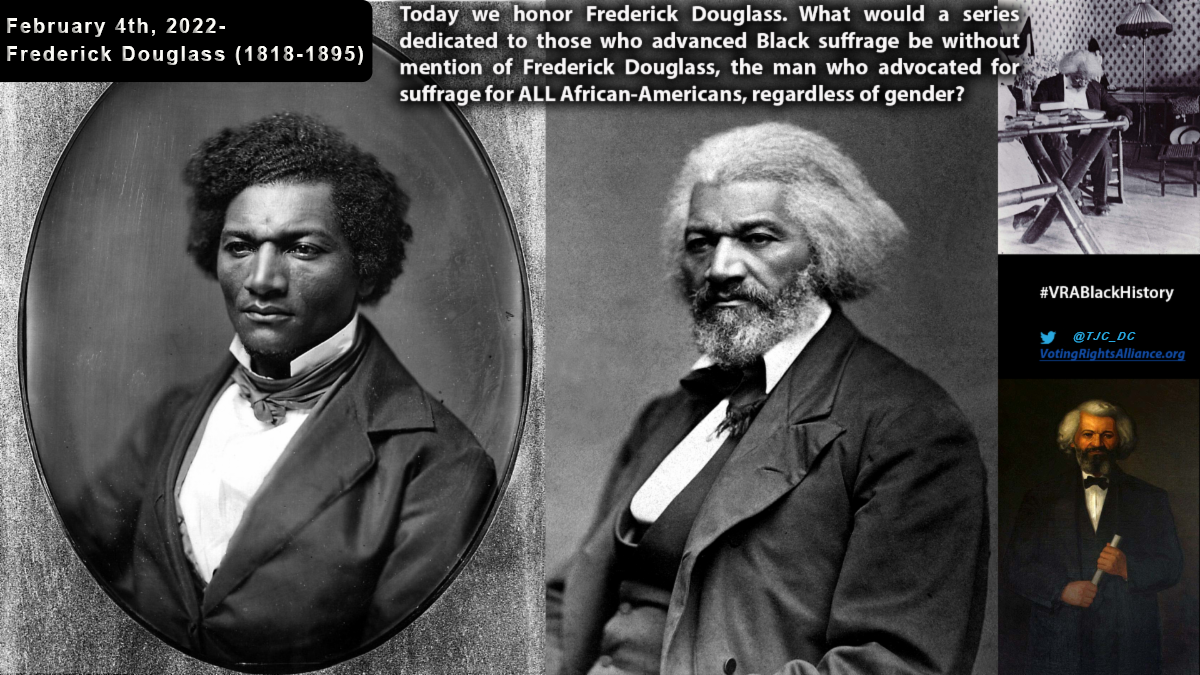
Today, February 4th, we honor Frederick Douglass. What would a series dedicated to those who advanced Black suffrage be without mention of Frederick Douglass, the man who advocated for suffrage for ALL African-Americans, regardless of gender?
Douglass tried to escape slavery twice before he was successful in running away as a fugitive. He escaped to Massachusetts with the help of his soon-to-be-wife, a free Black woman from Baltimore named Anna Murray, who later joined him in Massachusetts., where the two were married by a former fugitive slave.
Although his marriage papers listed him as "Frederick Johnson", it was here that Douglass was no longer known by his slave name of “Frederick Bailey”, or even the married name of “Frederick Johnson”, but he became best known as “Frederick Douglass”. Being a run-away slave, Douglass had to assume false names to avoid capture, and he took the name “Douglass” “from Sir Walter Scott’s 1810 epic poem ‘Lady of the Lake’”.
But there was another reason for Douglass changing his name: to vote.