
The Transformative Justice Coalition and the Voting Rights Alliance, in honor of Black History Month, are reviving the daily special series devoted to sharing the legacies and stories of the sheroes, heroes, and events in the fight for Black suffrage. This series was created in 2017 and will add 9 NEW articles this year. In addition to these daily newsletters all February long, this series also incorporates daily social media posts; an interactive calendar; and, website blog posts to spread the word broadly.
We encourage everyone to share this series to your networks and on social media under the hashtag #VRABlackHistory. You can also tweet us @TJC_DC to share your own facts.
Others can sign up for the daily articles at VotingRightsAlliance.org.
This article is written by Caitlyn Cobb. All the sources are linked throughout the article with a full reference list at the end of the full article which can be read by clicking the button at the bottom of the page). This is an introductory summary page.
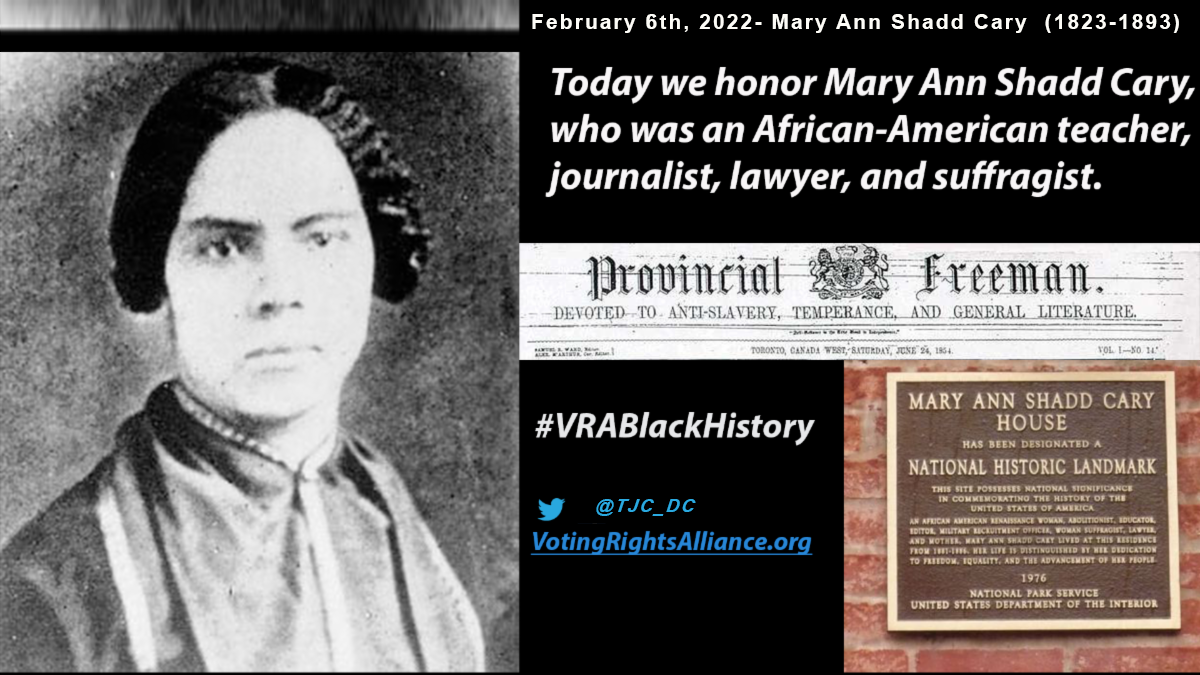
Today we honor Mary Ann Shadd Cary. "Mary Ann Shadd Cary, African American teacher, journalist, lawyer, and suffragist, was the oldest of thirteen children of prominent free Black parents. She edited a Canadian newspaper, the Provincial Freeman, for Black refugees who fled to Canada. She advocated the vote for Black women as race advancement, affiliated with the National Woman Suffrage Association, and developed legal arguments for suffrage under the 14th Amendment. Cary founded the Colored Women’s Progressive Franchise Association in D.C. (1880), which pre-dated the woman’s club movement by a decade, and linked the vote to women’s labor questions and entrepreneurship – all ideas far ahead of their time.
The Shadd family moved to Canada after the passage of the Fugitive Slave Act (1850), where she was a spokesperson and editor of the Provincial Freeman. She married Thomas Cary of Toronto but became a widow (1869). She moved to Washington, D. C., taught public school, and became the first woman student at Howard University Law School. Not permitted to graduate because D. C. did not admit women to the bar, she returned ten years later (1883) to receive her law degree at 60."